
A Hard Question Without an Easy Answer
Knowing when to say goodbye to your dog ranks among the hardest decisions any owner faces. There’s no single sign that makes the answer obvious. Instead, most vets recommend looking at your dog’s overall quality of life over time, rather than focusing on any one symptom. This guide offers a framework to help you think through this decision with more clarity, alongside your vet’s guidance.
Why This Decision Feels So Difficult
Part of what makes this decision hard is the fear of acting too soon, paired with the fear of waiting too long and letting your dog suffer unnecessarily. Both fears come from the same place: genuine love and care for your dog. There’s no way to remove all uncertainty from this process, but a structured way of looking at things can help.
Quality-of-Life Signs to Watch For
Many vets use a framework looking at several areas of daily life, sometimes called the “HHHHHMM scale” (Hurt, Hunger, Hydration, Hygiene, Happiness, Mobility, and More good days than bad):
Pain (Hurt)
Is your dog’s pain manageable with current medication and treatment? Consistent, uncontrolled pain despite treatment is one of the clearest signals that quality of life has declined significantly.
Appetite (Hunger)
Has your dog lost interest in eating, even with encouragement and appealing food? A sustained loss of appetite, rather than an occasional skipped meal, often reflects declining overall wellbeing.
Hydration
Is your dog able to stay adequately hydrated on their own, or does it require significant intervention? Ongoing dehydration despite support can indicate the body is struggling to maintain basic functions.
Hygiene
Can your dog stay reasonably clean, or does incontinence and reduced mobility make hygiene consistently difficult to manage in a way that maintains their dignity and comfort?
Happiness
Does your dog still show interest in things they used to enjoy — greeting you, watching the world, mild engagement with family? A dog who seems consistently withdrawn or distressed, rather than simply calmer with age, may be signaling something important.
Mobility
Can your dog move enough to do the basic things that matter to them — reach food and water, get outside, change position comfortably? Significant, ongoing mobility loss affects nearly every other area of quality of life.
More Good Days Than Bad
This is often described as the most telling factor of all. If your dog has more comfortable, engaged days than difficult ones, quality of life often remains reasonably good. When bad days start to consistently outnumber good ones, many vets consider this a meaningful signal.
Quality-of-Life Daily Log
Pick a calm moment each evening. Rate each area from 0 (very poor) to 10 (very good). Mark the day as good or bad. Bring the log to your vet and talk through the pattern together.
| Date | Hurt | Hunger | Hydration | Hygiene | Happiness | Mobility | Good or bad day? |
|---|---|---|---|---|---|---|---|
| ________ | ____ | ____ | ____ | ____ | ____ | ____ | ________ |
| ________ | ____ | ____ | ____ | ____ | ____ | ____ | ________ |
| ________ | ____ | ____ | ____ | ____ | ____ | ____ | ________ |
| ________ | ____ | ____ | ____ | ____ | ____ | ____ | ________ |
| ________ | ____ | ____ | ____ | ____ | ____ | ____ | ________ |
A log does not make the decision for you. It helps you see the pattern clearly when emotions run high.

Talking It Through With Your Vet
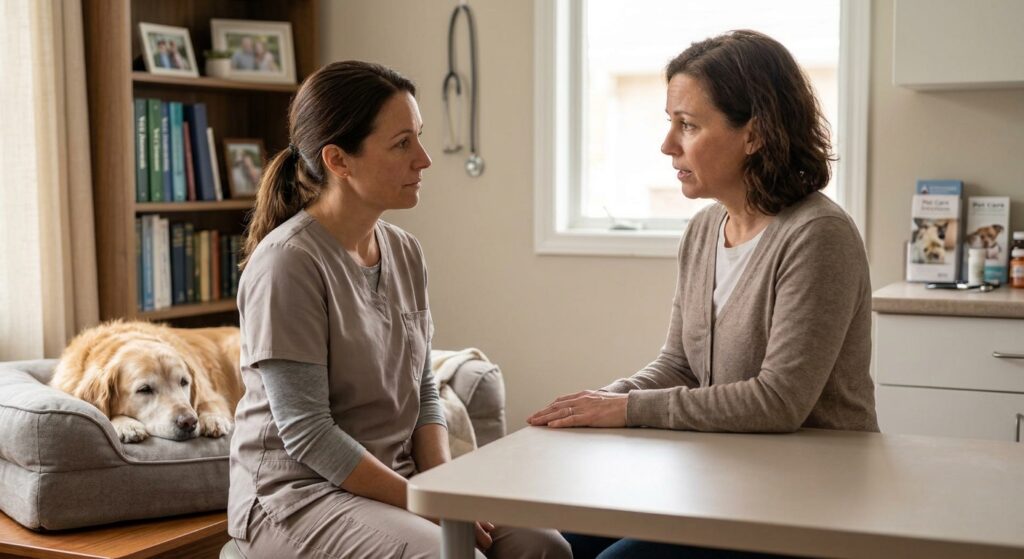
Your vet can offer an outside, experienced perspective that’s harder to access when you’re emotionally close to the situation. They can help you:
- Interpret specific symptoms in the context of your dog’s particular condition
- Discuss realistic expectations for how the condition will likely progress
- Explore whether additional treatment options remain reasonable, or whether the balance has shifted toward comfort-focused care
- Talk through the logistics and options for euthanasia, when and if that becomes the right choice
Many owners find it helpful to have this conversation before a crisis moment arrives, rather than only in the middle of an emergency decision.
Questions to Bring to Your Vet
Write your answers down before the visit. It is easy to forget questions when you feel upset.
- ☐ What is my dog’s condition, and how is it likely to change?
- ☐ Is my dog’s pain well controlled? What else can we try?
- ☐ Are there treatments left that are reasonable for my dog?
- ☐ What would comfort-focused care look like at home?
- ☐ Which signs mean we should call you right away?
- ☐ What are my options for euthanasia, and what can I expect on the day?
- ☐ Can the appointment happen at home, or at the clinic?
- ☐ What happens afterward, and what choices do I have?
Keeping Your Dog Comfortable in the Meantime
While you think things through, small changes can make your dog’s days easier. These do not replace your vet’s advice.
- ☐ Give your dog a soft, warm place to rest, such as one of the best orthopedic beds for senior dogs.
- ☐ Keep water and food close, and offer small, tempting portions.
- ☐ Help your dog move gently, and avoid slippery floors.
- ☐ Keep your dog clean and dry. Our daily hygiene routine for a senior dog with incontinence can help.
- ☐ Spend quiet time together doing what your dog still enjoys.
- ☐ Ask your vet about pain relief if your dog seems uncomfortable.
There Is No “Perfect” Timing
Many owners worry intensely about getting the timing exactly right. In reality, most vets emphasize that there’s rarely a single “correct” moment — there’s a window, and choosing thoughtfully within that window, guided by your dog’s quality of life rather than fear or guilt, matters more than pinpointing an exact day. The American Veterinary Medical Association provides additional guidance on navigating end-of-life decisions with your veterinary team.
Many owners worry about getting the timing exactly right. In reality, most vets say there is rarely a single correct moment. There is a window. What matters most is choosing thoughtfully within that window. Let your dog’s quality of life guide you, rather than fear or guilt. For general guidance on end-of-life care for pets, visit the AVMA website.
Giving Yourself Permission
Many owners feel guilt, regardless of when they make this decision — guilt for “waiting too long,” or guilt for “not waiting long enough.” This guilt is a normal part of how deeply people love their dogs, not a sign that the decision was wrong. Choosing to end suffering, guided by your dog’s actual quality of life and your vet’s input, reflects love and responsibility, not failure.
Many owners say the hardest part was not the decision itself. It was the days before it, when they kept asking themselves whether it was too soon. Some describe a quiet moment, such as a dog who stopped greeting them at the door. That moment helped them see what their dog was telling them. They often say they chose gentleness, and they felt the love behind that choice.
Frequently Asked Questions
Should I wait until my dog can no longer walk at all before considering euthanasia?
Not necessarily — mobility is one factor among several, and a dog could maintain reasonable mobility while experiencing significant pain, or vice versa. Looking at the whole picture matters more than any single symptom.
Is it normal to feel unsure even after deciding it’s time?
Yes, this is extremely common. Uncertainty and grief can coexist with a decision that’s genuinely the right one for your dog — feeling unsure doesn’t necessarily mean the decision itself was wrong.
Can a vet help me decide, or is this entirely up to me?
Your vet can offer valuable medical insight and an outside perspective, but the final decision ultimately rests with you, since you know your dog and your day-to-day life together in ways a vet visit alone can’t fully capture.
How can I tell if my dog is in pain?
Dogs often hide pain. Watch for panting while resting, restlessness, hiding, whimpering, or reluctance to move. Tell your vet what you see. If joint pain may be involved, read our guide on arthritis in senior dogs.
Does cognitive decline change how I decide?
It can. A dog with confusion or changes in sleep and behavior may still have good moments, but daily life can become stressful. Talk with your vet about how it affects your dog’s comfort. Our guide to canine cognitive dysfunction explains what to expect.
Can my dog still have good days with incontinence or mobility loss?
Many dogs do, with the right support. Good hygiene and mobility aids can make a real difference. Ask your vet what fits your dog. You can read about the best dog wheelchairs for senior dogs with mobility issues and the best dog diapers.
Should my other dog be there?
There is no single right answer. Some owners let a surviving dog say goodbye, and others prefer not to. Ask your vet for advice about your dogs. After the loss, our guide on helping a surviving dog cope with the loss of a companion may help.
This article is for informational purposes only and is not a substitute for professional veterinary advice. Always consult your vet about your dog’s specific health needs.
This decision carries real weight, and there’s no way to make it feel easy. If you’re navigating this now, our guide on coping with the loss of a dog offers support for what comes after this decision, whenever you’re ready for it.